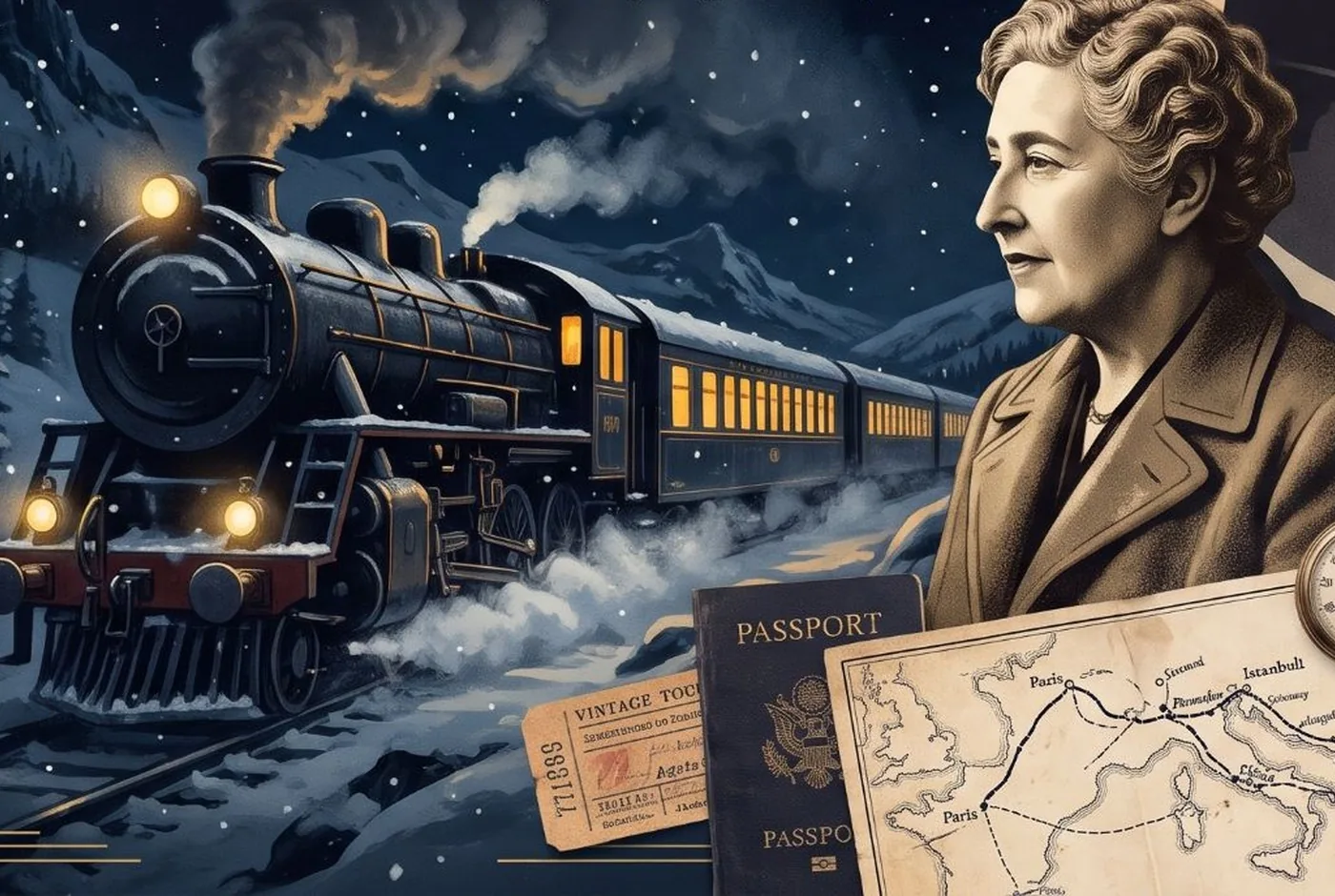
Sometimes the most memorable journeys begin with a question.
Murder on the Orient Express appeared in the United Kingdom on 1 January 1934, from the Collins Crime Club. In the United States it followed that February from Dodd, Mead as Murder in the Calais Coach. It is one of the best-known detective novels ever written, and it owes much of that fame to a simple idea: put a crowd of strangers on a train and take away the exit. (No spoilers ahead.)
A train with a reputation
The Orient Express was a service run by the Compagnie Internationale des Wagons-Lits. It first ran in 1883, and in 1919 the Simplon Orient Express opened a faster route through the Alps to the Balkans and Istanbul. The trains linked European capitals with polished dining cars and sleeping compartments. They also crossed borders, so passengers faced passport checks in the night, in a mix of languages. By the 1930s the name suggested luxury, politics and intrigue. Writers noticed.
What Christie actually knew
Christie travelled widely. In 1928 she journeyed to Baghdad, partly by train, and later joined archaeological expeditions in the Middle East with Max Mallowan, whom she married in 1930. She had also set a mystery on a train earlier, in The Mystery of the Blue Train (1928). Those experiences gave her a feel for long-distance rail travel, for its rhythms, and for the strangers thrown together by it.
What we cannot say is that one particular journey inspired the novel. Stories about stranded trains and specific hotels are often repeated, but reliable evidence for a single origin is thin. It is safer to say that she drew on a world she knew, and built the plot herself.
Why a train works so well
A train is a sealed room that moves. Everyone aboard is present, and everyone is a suspect. Time is fixed by a timetable. The corridor offers a limited number of ways to come and go, and the weather, here a snowdrift, can cut the carriage off completely. Christie turns these constraints into rules for the puzzle.
Poirot, and the shape of the puzzle
Hercule Poirot, the Belgian detective who had debuted in 1920, is travelling for no particular reason, and a friend who works for the railway company asks him to investigate. There is no chase and no car park to search. Instead Poirot does what he does best: he listens. The book proceeds through interviews, and the evidence is mostly talk, objects and the order in which things happened. The unusual structure means the reader holds the same clues as the detective.
The passengers are an international mixture, which fits the train. Each is a sketch with a little colour, an American businessman, a titled Russian lady, a British officer, and each lies or conceals something, as people do.
An ending people still argue about
Readers have debated the ending for decades without agreeing. Without saying what it is, I can say that the book does something more unsettling than naming a culprit. It leaves you weighing justice against rules, and many readers close it unsure what they think. That ambiguity is a large part of its life. The story has been filmed more than once, including Sidney Lumet's 1974 version and Kenneth Branagh's in 2017.
How the trick is done
Christie combines four things. The setting limits who can do what. The clues, among them a handkerchief, a pipe cleaner and a stopped watch, are laid in plain view. The characters are drawn lightly so you notice them just enough. And misdirection, the careful steering of attention, keeps you looking where the author wants. It is fair play, in the tradition of the genre. You could solve it. Almost nobody does.
What the book is not
It is not a travel guide, and it is not a record of a real crime. The Orient Express here is a stage, and a well-chosen one. The pleasure lies less in where the train goes than in who is aboard, what they say and what they leave unsaid. Christie knew that readers love a closed circle, because it promises that the answer is already in the room. Reading it again, knowing how it ends, is a different pleasure: you watch the craft at work, line by line, and see how much was hidden in plain sight.
Your next journey
Go back to a mystery you think you know and read it slowly this time, watching how the author handles each clue. Or pick up a detective story you have never tried, and see if you can beat the detective to the answer. Pencil in hand, we say. The best ones reward a careful reader.